
Long known as an IT outsourcing hub, India is now emerging as a major data centre hotspot as new investments pour in. Despite generating around 20% of the world’s data, India hosts only 3% of global data centres. This means that while it produces a huge amount of digital information, much of its data is stored and processed outside the country.
By the end of 2025, the country had amassed significant capital for new developments. Google committed $15 billion toward advancing AI data centre projects with the Adani Group and Bharti Airtel, Microsoft pledged $17.5 billion, Amazon announced $35 billion, and both Meta and Tata are also building their own hyperscale data centres.
Sunil Gupta, Co-Founder, CEO and Managing Director of Yotta Data Services, an Indian data centre start up, explains that “global social media and internet platforms do not host in India, even though 30-40% of their global users are Indian. These platforms routinely cite architectural constraints or cost concerns.” However Gupta notes that this “dynamic is now beginning to change” thanks to “the recent Union Budget announcement offering a long-term (20-year) tax holiday for foreign cloud operators serving global demand from Indian data centres.”
Without domestic chip manufacturing capabilities, India’s best chance to participate in the AI boom is through data centres, but much of India’s current data is routed through primary hubs like Singapore, which can create delays because the long distance increases latency and slows performance.
By 2028 India is projected to be the world’s largest data consumer, and while there is a clear need for local data centre infrastructure development Shweta Tyagi, Chief Functionary of the India Water Foundation points out, “the challenge…is not digital growth per se, but aligning it with hydrological realities and ensuring that technological infrastructure does not outpace ecological limits”. Especially given that India is home to 18% of the global population and has only 4% of the world’s water supply.
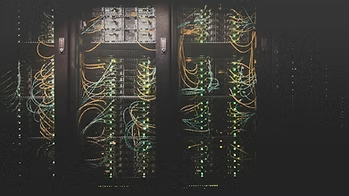
Data centres are the physical facilities that store and process cloud storage, emails, social media, streaming services or website information, while AI data centres are specifically designed for artificial intelligence workloads, training large language models and running AI tasks in real time. These AI data centres therefore require more powerful hardware and intensive computing, and they typically consume significantly more electricity and water than standard data centres.
Gupta says that “the vast majority of data centres in India—including Yotta—use air-cooled chillers, where water operates in closed loops,” meaning water is reused within the system and is not continuously lost through evaporation. He adds that “The narrative that data centres are worsening India’s water scarcity problem is therefore not accurate” and maintains that “water is not a binding constraint for data centre growth in India today, and with modern cooling designs, it is unlikely to become one.”

Even if individual sites use water efficiently, the rapid growth of data centre capacity could raise significant cumulative water demand. According to the Ministry of Housing and Urban Affairs, India’s urban water supply is 135 litres per person per day. A small 1 MW data centre using traditional cooling requires an estimated 26 million litres of water annually, which is equivalent to the domestic water needs of approximately 528 people each year. India currently has 1.4 GW operational data centres, 1.4 GW under construction, and 5 GW in the pipeline.
The environmental sustainability of these data centres has become a major topic of discussion in relation to the future of AI. Labanya Jena, the Director of the Climate and Sustainability Initiative, reflected on an article he published just over a year ago on powering India’s data centres, saying that “in 2024 nobody was talking about data centres and energy issues around data centres.” Jena adds that the energy reality behind the data centre boom is still heavily fossil-fuel based: “fossil fuels are contributing close to 71-72% of total energy generation in the country…and I’m not very confident that it will reduce drastically or significantly in the next five years.” He says that with the current energy mix “data centres will indirectly contribute to additional coal capacity as they need 24/7 energy.”
Rishik Teepireddi the Vice President and Business Strategy and Renewable Energy at CtrlS Datacenters, says that “AI workloads have fundamentally reshaped the energy conversation for data centres…Renewables are critical for sustainability and cost stability, but they are intermittent by nature. Batteries are improving rapidly and are increasingly viable today for short-duration backup and load balancing.” However he points out that natural gas and thermal power are still necessary in ensuring uninterrupted, long-duration operations.
“For a long time, the developmental story in India has been that the more infrastructure you build, the more jobs and development it brings… This was true in the early days with dams… we were concerned about displacement and environmental harm, but the trade-off was electricity” says Aahil Sheikh, a digital policy researcher. The assumption is that the long-term benefits of AI and economic growth will outweigh the immediate environmental costs. Sheikh adds that the government is banking on AI to help address climate challenges, but he remains cautious about the current impact. “What the government’s really hoping for is that AI is going to be helpful for us to tackle climate change… it’s a pretty noble ambition… but my concerns are more in the here and now, and I do see that in the present day there are a lot of consequences that I hope are better addressed”, says Sheikh.
India does not have a national AI policy, and regulation remains fragmented. There is currently no mandatory framework for assessing AI’s environmental impact or the water and electricity use of data centres. Sheikh suggests that the first step should be to make “the environmental impact assessments (EIA) mandatory for the development and deployment of AI models and that [this] could also be expanded for data centres and the kind of resources that they consume.”
Jena says that policy could spur decarbonisation, since data centre companies are “highly profitable” and therefore have the means to reduce their emissions. Tyagi laid out possible solutions to incentivise responsible water use; “State governments could require that new large data centres in over-exploited groundwater blocks meet a defined percentage of cooling demand through recycled water… Differential water tariffs like charging higher rates for freshwater abstraction while offering concessional pricing for treated wastewater would shift the economics decisively… and mandatory disclosure of water intensity metrics and third-party audits would create reputational incentives and enable regulators to assess cumulative impacts.”
Transparency is critical in ensuring data centres remain viable in such a water stressed country. Sheikh highlights that companies may claim they use recycled water, “but they never go into the specifics of how much recycled water [they’re] using or how much clean water,” making it hard to distinguish genuine sustainability efforts from greenwashing. This is especially troubling when data centres can rely on third-party operators, meaning the companies using the facilities may not have to report any water or energy footprint associated with their operations.
Tyagi similarly warns that the cumulative impact of clustering data centres in tier I cities like Mumbai, Hyderabad, Chennai and Delhi-NCR can intensify competition over already scarce water resources. Some groups like Adani, Yotta Data Services as well as Ctrl S, are looking to diversify and expand in tier II, tier III and even tier IV cities. Jena highlights that “tier three cities are cooler,” suggesting that these smaller, less densely populated locations could provide natural temperature advantages and reduce the need for heavy water-dependent cooling from water-stressed metropole regions.
India’s need for data centres is undeniable. As the world’s most populous nation and one of the fastest-growing digital consumers, India must build capacity to host and process the data it generates. But expansion cannot outpace water availability, as Tyagi says, “India can ensure that industrial expansion supports, rather than compromises, long-term water security and equitable access.”