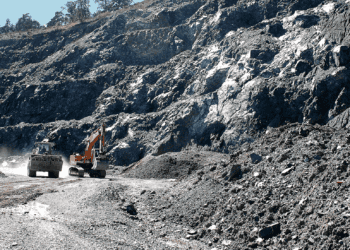

In the Guelmim-Oued Noun region of southern Morocco, known as the “Gateway to the Sahara,” pomegranate, fig, and carob trees are thriving thanks to irrigation water provided by a solar-powered desalination plant. This plant, established in 2024 to address drought-related challenges in the region, has also reduced operating costs by replacing diesel with solar energy.
Inside the Solar Desalination System
Solar-powered desalination uses renewable energy to extract fresh water from brackish water sources, thus reducing reliance on fossil fuels and minimizing greenhouse gas emissions.
“Using solar energy to power the water desalination plant in Guelmim, southern Morocco, has delivered several strategic advantages”, said Maxime Therrillion, Head of Business Development at OSMOSUN — the company that implemented the solar-powered desalination facility for SAND TO GREEN, a French-Moroccan Company, to irrigate a 38-hectare eco-farm in the Moroccan desert as part of a regenerative agriculture project.
He explained that replacing diesel with solar significantly reduces operating costs, offers a fully carbon-free solution, and provides complete autonomy in remote areas where fuel supply chains are unreliable.
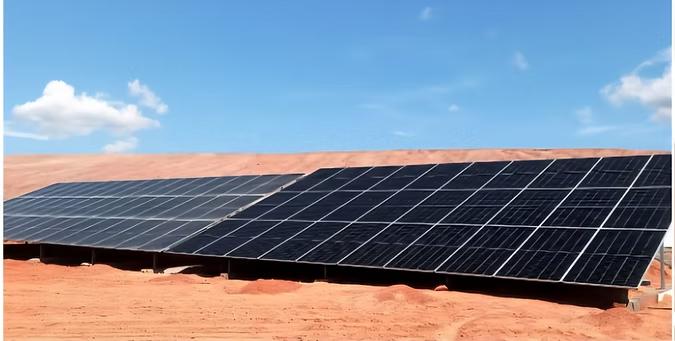
Describing the operational process, he explained that water is first drawn through a borehole, then passes through multi-media filtration for pre-treatment, before undergoing reverse osmosis. The final stage involves pH correction to guarantee water quality. Therrillion emphasized that the plant faces the same operational challenges as any conventional desalination unit, except for a simpler and more reliable energy supply, thanks to solar power.
The plant produces up to 40 cubic meters of water per day, including 4 cubic meters powered entirely by solar energy, he explained. Therrillion noted that this corresponds to an estimated 12 kWh of daily energy savings, calculated at 3 kWh per cubic meter of solar power generated.

Although the desalinated water is technically suitable for drinking, it is currently used exclusively for irrigation. He added that the quality and salinity levels of solar-powered desalinated water are essentially identical to diesel-powered systems, since both rely on reverse osmosis. What distinguishes their model, he explained, is OSMOSUN’s patented design, which allows the system to operate directly from solar power without the need for batteries.
Reflecting on Morocco’s broader context, he noted that the country’s increasing water stress highlights the strong potential of solar-powered desalination for remote communities, both for agricultural use and drinking water access.
Another successful project, a partnership between Morocco, China, and France, in the Erfoud oasis in southeastern Morocco, has recently achieved a 100% solar-powered desalination plant, which has improved the cultivation and productivity of strategic crops such as palm trees, moringa, olives, barley, and mimosa trees in the oasis.
These local successes reflect a broader national shift toward solar desalination.
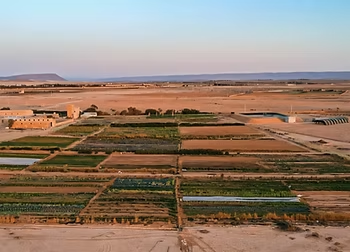
Morocco faces an escalating water crisis driven by population growth and climate change. A Moroccan study indicates that the country is likely to experience significant climatic shifts over the next century, including a projected 10–20% decrease in rainfall by 2050. Meanwhile, the population is expected to grow by 11 million between 2019 and 2050, reaching 46 million, increasing pressure on already scarce water resources.
Cutting Costs and Carbon: Why Solar Beats Diesel
To confront these challenges, Morocco has expanded its reliance on desalination. The country currently operates 17 desalination plants producing 345 million cubic meters of water annually. Many of the older plants run on diesel, making them highly energy-intensive and environmentally costly. Globally, desalination plants emit approximately 76.2 million tons of carbon dioxide each year, underscoring this environmental burden.
A study titled “Hybrid Solar Desalination System for Rural Morocco: Development and Performance Analysis” shows that traditional diesel-based desalination systems require complex and costly infrastructure, depend on grid electricity, and incur very high maintenance and operating expenses. As a result, production costs range from US$1 to US$9 per cubic meter. In contrast, the study concludes that solar-powered desalination is an economically viable, sustainable, and environmentally friendly alternative that significantly reduces operating costs once installed.
In response, Morocco is shifting toward a new generation of desalination facilities powered by renewable solar energy. Several large solar-powered plants are under construction and are expected to be operational by 2027, including a major plant in Casablanca that is set to become Africa’s largest, with a capacity of 300 million cubic meters per year.

According to the study, adopting solar energy for desalination offers an effective and urgent solution for water-scarce regions. Through this shift, Morocco aims to enhance both water and energy security and advance sustainable development by increasing the share of renewable energy in its electricity mix to over 52% by 2030.
While the high initial cost of solar-powered desalination plants remains the main obstacle to their expansion, experts argue that the long-term benefits outweigh the upfront investment.
This aligns with the view of Dr. Hesham Eissa, a board member of Dcarbon Global for Environmental Consultancy and Sustainable Development, who notes that Morocco faces shortages of both water and fossil fuels, yet benefits from hosting the largest solar power plant in the Middle East. This facility provides the country with clean energy while powering seawater desalination projects, offering a dual advantage: lowering fossil fuel imports and reducing emissions from diesel-powered desalination.
Dr. Eissa emphasizes that securing financing is the primary challenge for developing countries seeking to adopt this approach. Morocco’s experience stands out because it has successfully mobilized the substantial funding required for such projects through partnerships with the private sector and international partners, as well as through grants.

He further notes the importance of presenting desalination initiatives as climate-focused projects, given their direct role in mitigating climate impacts—particularly water scarcity. Doing so, he argues, opens doors to green finance institutions and climate funds.
Regarding the use of desalinated water, Dr. Eissa explains that its application depends on the degree of desalination and salt content. The water can be used for domestic, agricultural, and industrial purposes, and it can also be made suitable for drinking once it meets internationally recognized salinity standards.
Solar-powered desalination is emerging as more than a technological alternative—it is becoming a strategic pathway for resilience, one that Morocco is increasingly positioning itself to lead in the region.