
The Story of a City in Argentina
Between June and August 2025, almost 955 million people around the world endured 30 days of dangerous heat due to climate change, according to a report by Climate Central. Spain experienced its hottest summer on record, with 33 days under a heat wave. With this scenario, cities in the Southern Hemisphere are preparing to avoid the worst effects of high temperatures.
Last summer, Argentina was the South American country that recorded the largest temperature anomaly on the continent, with 0.9°C above the 1990–2021 average, according to another Climate Central report. The country suffered 40 days of dangerous heat during that period. Dangerous heat is defined as days in which temperatures surpass the 90th percentile of historical observations. The city of Córdoba, in central Argentina, topped the ranking of South American cities with temperature anomaly. It recorded 1.2°C above the average and experienced 22 days of dangerous heat.
The forecast for October, November, and December from Argentina’s national meteorological service anticipates a quarter with above-normal temperatures for the province of Córdoba. In this context, the capital of that province is already preparing for the 2025/2026 summer with different actions, some unprecedented in the country
Heat waves and health: preparing the community
From the School of Medical Sciences at the Córdoba National University, an innovative measure was carried out: the first heatwave drill in Argentina. It took place on September 18 in an area known as Pueblo Alberdi, which includes the neighborhoods of Alberdi, Alto Alberdi, Marechal, and Villa Páez. That area was chosen due to prior temperature data, which places it among the hottest areas of the city, and the high social vulnerability of the population in that sector. Experts consulted agreed that the greatest health risks appear when these two factors combine.
Since 2022, that school, together with the School of Exact, Physical and Natural Sciences, has been conducting surveys on the impact of floods in the area next to the Suquía River. Later, they added the temperature factor, and last year, they included health-related questions. In 2024, almost 52% of respondents said they had heat-related physical symptoms. More than 24% had to modify their work, and 11.4% needed medical assistance due to high temperatures. It was therefore decided to carry out a heatwave drill to prepare the community for extreme weather events and to promote awareness, solidarity, and practical actions.

“Actually, it was a simulation. A real drill is never announced, but we wanted everyone to know in order to empower the community,” said Susana Vanoni, one of the project directors.
For the activity, all neighborhood residents were contacted through social media and official text messages from the local government. Hydration stations, medical tents, ambulances, and sustainable cooling spaces were set up. Medical school students, members of the G.E.E.R. Foundation, several government agencies, and students from Haroldo Andenmatten High School were part of the activity.
100 volunteers of the G.E.E.R. Foundation participated in the simulation. This institute specializes in emergency training and played a crucial role in the project. Some of these volunteers were dressed up as neighbors and, in the middle of the activity, pretended to faint. Neighbors then had to carry out an initial assessment and decide whether to send the person to a medical tent or if the patient could walk there, accompanied.
“The idea was for neighbors to know how to act in everyday reality,” Vanoni added.
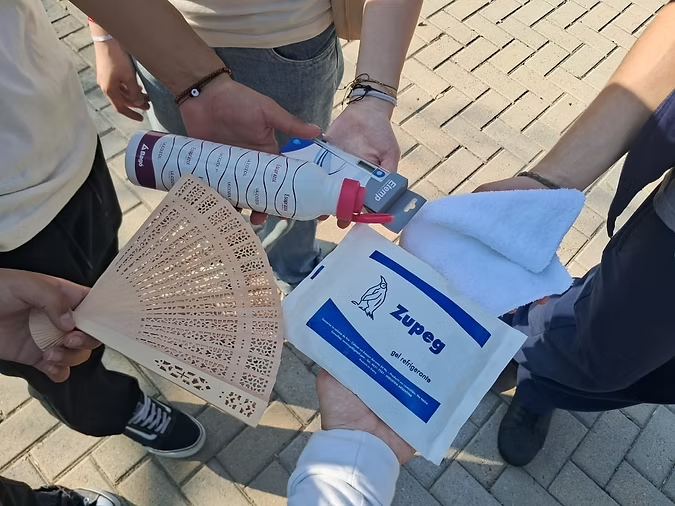
To promote prevention, residents were also given cooling kits containing a reusable water bottle, a small towel to moisten the body, sunscreen, an energy bar, a cooling gel pack for the freezer, a thermometer, a fan, a QR code with emergency hotlines, and recommendations on when and how to use each item.
The ultimate goal of this initiative is for the government to establish a climate-controlled area in the neighborhood powered by sustainable energy (A.C.C.E.S.O. by its Spanish acronym). This would be a safe, climate-controlled, and easily accessible space (no more than 15 minutes away) open for residents to cool down for a few hours a day during a heatwave. They should include air conditioning, Wi-Fi, and be able to host several neighbors.
“When it’s hot and the power goes out but you don’t have resources, you can’t just grab your laptop and go to a café,” Vanoni explained. These ACCESOS could be created in familiar neighborhood spaces such as community centers, libraries, or sports clubs, among others.
University, a place to test solutions and scale them up
The Blas Pascal University is also working to prepare the city’s infrastructure for high temperatures. Its Institute for Research in Sustainable Development has been studying the urban heat island phenomenon for several years. In this project, the temperature in the city is also measured in relation to vulnerability. Studies reveal that 20% of Córdoba’s urban population lives in areas of high climatic vulnerability.
To measure the temperature, this project uses satellite images. With these thermal images, they create heat maps, explained Lucas Vanoli, an environmental management graduate and member of the research team at the Blas Pascal University. The satellite passes every 15 days at 11 a.m., and the data is then interpreted and corrected to eliminate biases related to the time of day it is measured. In addition, temperature measurements are taken on the ground to validate the satellite data.
“Ideally, we would like to have many temperature measuring stations throughout the city to have permanent data and to measure the temperature increase throughout the day,” explained Vanoli.
The heat island phenomenon is defined as the difference in temperature in an urban area compared to the periphery or the average temperature of the city, as explained by Vanoli. According to the university’s studies, this difference can exceed 5° C.
With this data, the institute created a project to implement and test low-cost, nature-based solutions to reduce the effect of heat islands in the city. The initiative called “RefresCOR” was awarded in the Innovate for Climate Challenge 2025. This contest was powered by Cordoba’s City Hall and Bloomberg Philanthropies. The university project will receive a total of 5000 dollars by November to implement the solutions.
“We already know some initiatives help cool the air, now we want to find out by how much they do,” Vanoli explained.
In the university garden, they are testing some of these initiatives. An area in the parking lot was painted white, and now they measure the temperature in that painted area as well as in areas with traditional pavement. Based on current measurements, it is already evident that the temperature is decreasing in the painted area. The team expects to have conclusive results by the end of this summer.
“The goal is to take the university´s pilot project to the city hall and to large real estate developers, as well”, Vanoli said.
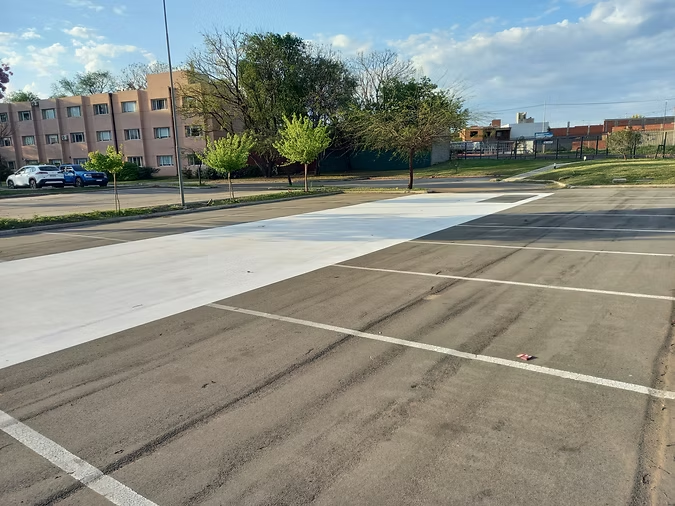
At Blas Pascal University, they are also measuring how vegetated areas lower the temperature, among other solutions.
Applied science: the role of government and the residents
Following the simulation exercise powered by the Córdoba National University, Cördoba´s City Hall created a working group to respond to heatwaves.
“We realized that many actors were working separately on the same problem, so we decided to take responsibility as a government,” said Gabriel Martín, Córdoba’s Secretary of Environment.
The first meeting of this group took place last October 1st and was an internal reunion of several areas of the government. This group will create a government protocol to respond to heat waves, drawing on studies conducted by the universities mentioned, among others.
“With summer approaching and little time left, we’re focusing on the hottest and most vulnerable areas, which are the most critical zones”, Martin explained.
The protocol aims to define the roles of each government office during heat waves, designate cooling areas for residents, and establish a communication plan for reaching the public in such events. Experts consulted agree on the key role that community involvement plays in addressing issues like this.
“We carried out the simulation in a community we’ve known for years, we didn’t just show up as professors,” explained Susana Vanoni. She added that, after the exercise, residents were happy because they knew the results could lead to real action.
Lucas Vanoli, meanwhile, emphasized: “It’s important that people see what we do, because we do it for them.”