Community leaders, builders, and dreamers gathered to discuss a vision for the future. One in which the people, the planet, and its institutions can find balance and address the challenges of tomorrow, offering a reminder that, despite a lack of administrative support, there is important work to be done and people motivated to do it.
On a quiet Monday afternoon in Boston’s Seaport district, as rain pattered against the windows and a swell of ethereal music rose from the stage, an energized group of artists, engineers, architects, conservationists, philanthropists, and academics from around the globe filed into their seats.
The air in the auditorium space at the Institute of Contemporary Art was buzzing with excitement for the Model of Architecture Serving Society (MASS) event, Abundant Futures.
Featuring performances, interactive experiences, breakout sessions, and talks from an impressive slate of speakers, Abundant Futures showcased the important social and environmental work being done around the world and conveyed a refreshing message of optimism for the future amid uncertainty.
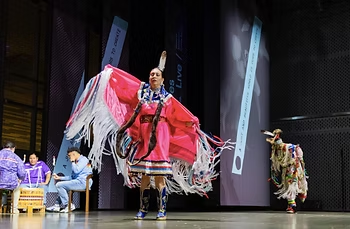
Over the course of the day, speakers covered topics such as maternal health, biodiversity, cultural memory, and investment in local communities, arguing that the built environment, meaning our buildings, roads, parks, and utility systems should be designed mindfully for community members, sustainably to ensure a green environment, and beautifully, because, as Alan Ricks, Co-Executive Director and Founding Principle at MASS put it, “Beauty is not decorating, it is evidence of dignity.”
This event comes at a time when many working in healthcare, sustainability, ecology, racial equity, and social development are operating under an administration that tends to create more roadblocks than opportunities.
One speaker, Mohamed Ali Diini, founder and director of Iftin Global, a nonprofit based in Mogadishu, Somalia, spoke to these obstacles.

Mohamed’s work in his home country of Somalia began with a mission to help young people find jobs through skills training and employment opportunities; however, participants struggled to stay focused and engaged. He realized that this wasn’t due to a lack of talent or earnestness, but a result of untreated trauma brought on by violence, displacement, and poverty.
“Trauma damages the part of the brain that allows us to imagine,” he said. These students were unable to imagine their own future.
The solution was to combine mental health therapy with job training. With trauma-informed resources integrated into the skills training process, Mohamed observed significant results: employment rates increased by 11%, and more participants sustained their progress. “Healing goes hand-in-hand with opportunity,” he said.
In collaboration with MASS Design Group, Iftin Global designed a campus to house the organization’s operations and provide a space for young people to heal and develop the skills needed to advance their careers. However, before construction could begin, the U.S. government dismantled USAID, a crucial supporter whose departure killed the project.
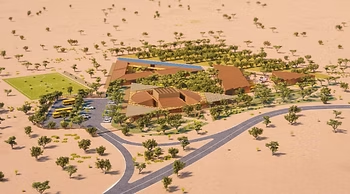
The closure of the U.S. Agency for International Development led to the cancellation of thousands of contracts, including Iftin Global’s, across global health, agriculture, education, and humanitarian aid. Thousands of agency employees were either fired or placed on leave, ushering out an era of American-led foreign aid.
Around the same time of USAID’s dismantlement, the Environmental Protection Agency (EPA) announced in March that it would roll back several regulations related to air quality, including the endangerment finding, which demonstrates the health dangers of greenhouse gases. The proposal would also repeal greenhouse gas emission standards for fossil-fuel power plants.
EPA Administrator Lee Zeldin announced boldly that these regulatory rollbacks would bolster the American energy sector and dismissed previous policy, saying, “today the green new scam ends.”
The administration’s abandonment of international aid projects, coupled with its disregard for climate change indicates a cultural landscape shifting away from the work that so many attendees of Abundant Futures came to promote.
Despite recent policies, headlines, and setbacks, the message among this group was surprisingly and overwhelmingly optimistic.
The speakers argued that we can create a promising future where wellbeing, belonging, and flourishing are shared foundational values. They demonstrated that today’s adversity won’t stop them from building spaces that empower communities and benefit the environment, because this work must continue.
In one panel discussion on investing in the next generation, the speakers prompted young people to get gritty and get to work.
Geraldine Laybourne, former TV executive at Disney-ABC and Nickelodeon, said to the students in attendance, “don’t wait for your elders to come up with new ideas.”
Former Massachusetts Undersecretary of Criminal Justice and civil rights advocate Sandra McCroom added that young people should “be fearless.”
This was the spirit of the event — a headfirst dive into the issues that too often go overlooked—a show of resolve in core beliefs and goals, with a message of hope rather than fear.
In creating Abundant Futures, MASS Design Group assembled a team from several fields, united by architecture, and presented a cohesive, optimistic vision for the future that cut through the cloudiness of recent days. The event showcased inspiring work that doesn’t stop in the face of adversity–work that is now more important than ever.
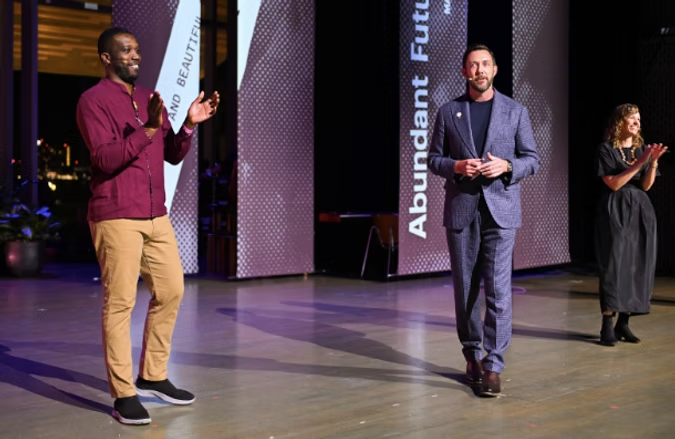
“Intention coupled with the right action leads to inspiration that everybody deserves,” said Christian Benimana, Co-Executive Director and Senior Principal at MASS.
Model of Architecture Serving Society (MASS), the curators and hosts of the day’s proceedings, is a nonprofit architecture and design firm that believes design is a tool for positive social and environmental impact. For the full list of speakers from Abundant Futures, click here.