
Plastic is great. Thanks to their durability, lightweight nature, and versatility, they keep our foods fresh via packaging, revolutionize healthcare through single-use plastics, and make our vehicles lighter and more fuel-efficient. To truly grasp their impact, one must examine the following statistic: plastic production grew from 2 million tonnes in 1950 to 348 million tonnes in 2017 and is still expected to double in capacity by 2040. However, despite their widespread use, plastics are notoriously difficult to recycle. A recent survey by The Recycling Partnership showcased that 80% of people believe that recycling their waste makes a difference; reality offers a striking difference, with only 9% of global plastic being recycled.
Plastics are made by linking chains of different molecules, creating diverse types of plastics with distinct qualities. Everything from home insulation to food packaging to cigarette filters contains various plastic types. To better classify them, the Society of Plastics introduced the Resin Identification Code system in 1988, dividing plastics into seven categories. Those higher on this scale, such as multi-layered plastics, are generally more difficult to recycle. Moreover, many products are made of multiple plastic types. Take a takeaway coffee cup: its outer layer is structured paper, the inner lining is polyethylene (type 2) for waterproofing, and the lid is often polystyrene (type 6). Since the layers are bonded, separating them for proper recycling is challenging. While this combination of materials is practical for use, it complicates the recycling process significantly.
Today, the world relies on mechanical recycling to recycle most of its plastics. This process involves collecting, sorting, shredding, washing, and reprocessing plastic waste without altering its chemical structure. The plastic is melted down and formed into pellets for remanufacturing.
Meet EP Investing — now live and free through July 15th.
1,300+ companies · 350+ investors · 185+ grants. Capital discovery for the energy transition.
While the status quo is still in place, the process still faces many hurdles, particularly during the sorting phase due to the different forms, types, and additives plastics come in. Mechanical recycling requires a feedstock of near-uniform plastic types to avoid contamination, and considering that more than 10,000 different additives can be added to a plastic to enhance its technical properties or change its color, scalability and subsequently competing with virgin feedstock becomes quite difficult. This often leads to “downcycling,” where recycled plastic is used in lower-value products, as highlighted in a report by Zero Waste Europe: new bottles contain, on average, 17% recycled PET despite a recycling rate of 50%, with the rest being used in lower-grade PET applications like trays or film.
A conversation with Delphine Largeteau, Global Sustainability Consulting Director at Schneider Electric (SE), highlighted ways of improving the process. When asked how Europe can mitigate the challenges associated with sorting inefficiencies and feedstock contamination, Delphine emphasized the importance of software-defined automation systems, particularly SE’s Ecostruxure Automation Expert, in increasing recycling rates. These systems enable devices and processes within a recycling facility to connect seamlessly regardless of original equipment manufacturers, allowing for fewer human errors, more scalability, and ease of integration of advanced tools like AI to drive optimization, all crucial to improving the economics of plastic recycling. “The software-defined approach to automation is expected to reduce engineering costs linked to automation by 30%,” says Delphine.
But whilst mechanical recycling has its positives, the nature of plastics means that you can only recycle plastics once or twice until their components degrade, thus only postponing disposal as opposed to creating a closed loop. Chemical recycling is a process that breaks down plastics into their molecular building blocks, which can be reprocessed in refineries to produce new plastics. This method can recycle contaminated and low-quality plastics, thereby widening the range of recyclable feedstocks. However, barriers remain, both from an economic and environmental perspective. A Department of Energy study highlighted that the environmental impacts of chemical recycling tend to be 10-100 times higher than virgin plastics, particularly due to their low yields and high energy requirements.
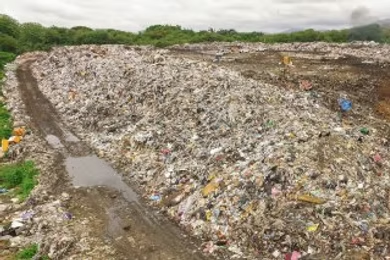
Moreover, what happens with the plastic that isn’t recycled is another issue that plagues the industry. In 2018, the world saw roughly 30% of its plastic waste being mismanaged either by open dumping, open burning, sending to sub-part landfills, or sending to oceans. The dangers of this mismanagement are severe. Open dumping exposes nearby communities to hazardous chemicals that can leach into soil and water supplies, increasing the risk of diseases. Open burning releases toxic gases such as dioxins and furans, which are linked to respiratory issues, cancer, and other serious health problems. Subpar landfills lack proper containment, allowing microplastics to seep into groundwater and ecosystems. When plastic waste reaches oceans, it breaks down into microplastics that are ingested by marine life, entering the food chain and impacting biodiversity and human health.

Most of this mismanagement occurs in emerging economies such as India, Indonesia, and Vietnam due to inadequate waste management infrastructure, rapid urbanization, lack of funding for recycling programs, and insufficient enforcement of environmental regulations. Nonetheless, Western companies like Schneider Electric do have expansion plans for the region. “Asia…is a significant focus due to high plastic production and urgent recycling needs,” says Delphine.
Overall, plastic waste management is not easy, but improving sorting systems appears to be a low-hanging fruit with significant potential for impact. Echoing Delphine’s remarks, technological innovation is key here. Initiatives such as the HolyGrail 2.0 project in Europe, which leverages digital watermarks to improve sorting accuracy, demonstrate how technology can enhance recycling efficiency and reduce contamination. The project’s success in phase 1 and phase 2 showed that digital watermark technology can achieve more granular sorting of packaging waste at scale, paving the way for broader adoption. Awaiting the final public report, outlining the techno-economic analysis of the watermarking technology, is exciting and potentially revolutionary for the mechanical recycling industry.
Additionally, pressure from companies can help drive change and mitigate the price gap between virgin and recycled plastics. A survey by McKinsey showcased that 28% of brand owners have committed to a set target and timeline, with the mean targets being 98%. But the end result here is that a collective effort is vital. Considering the nature of plastic degradation during the mechanical process and the short-term skepticism surrounding the growth of chemical recycling, a concerted focus on reducing plastic consumption at the source is essential. Otherwise, recycling systems will remain overwhelmed.
Meet EP Investing — now live and free through July 15th.
1,300+ companies · 350+ investors · 185+ grants. Capital discovery for the energy transition.