
South Africa has $13.7bn in grants, loans, and concessionary finance pledged by Europe and Japan under its flagship Just Energy Transition Plan (JET).
“For now, that’s paper money. Firstly, the money comes slowly in drips, with the evidence showing that about $1bn has been handed out to date,” green energy transition monitors like Tapuwa Nhachi, caution.
Equally concerning is the challenge of usage. Much of the concession finance pledged and ready for disbursement remains idle due to a lack of “bankable” green energy projects. This is creating a “packaging gap”, says Musa Mabesa, the principal executive officer of the South African Government Employees’ Pension Fund (GEPF). Mabesa has a front-row view of how green finance is rolling out in South Africa, as the GEPF is Africa’s wealthiest public-sector pension fund. It controls assets of R2.6 trillion ($158bn).
Meet EP Investing — capital discovery for the energy transition.
“It’s a dilemma arresting green energy uptake progress not only in South Africa, but across the continent,” he says. This is Africa’s dilemma: available green transition funds, but unavailable bankable green projects.
He then lays out the scale of the problem. While South Africa is seeing a solar, wind, hydrogen, and biogas boom, with 7 GW of utility-scale green electricity coming online, executing these projects is challenging, not least due to a lack of sophisticated, affordable technical skills.
“Finding bankable projects in green energy requires extensive research, profit modelling and due diligence. When a worthy project comes up, private financiers must jump through hoops of red tape, complicated licensing laws, and tax processes,” he says.
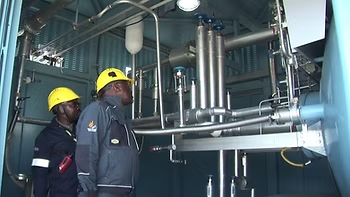
Because of bureaucratic hurdles, some identified projects struggle to reach financial close – yet too much expertise, time, and money would have been used before a single solar power plant or wind farm has been erected, he explains.

Given that the primarily Western European financiers who have pledged to finance South Africa’s green transition are risk-averse, the South African government, using its pension funds, has been proactive. They are increasingly filling the “packaging gap” to fund hydrogen, solar, wind, and biomass plants, as well as transmission grid expansion projects.
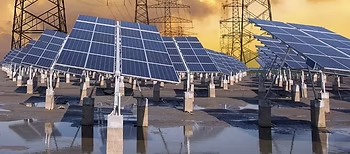
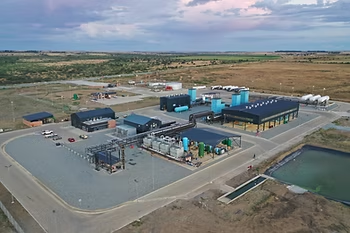
The South African public pension fund has been accomplishing this in several ways. The GEPF has invested in start-ups that add solar, wind, or biogas to South Africa’s grid, either as a sole or co-financier, since 2014. For example, it has financed a stake in the 100MW Xina Solar One thermal plant in the sunny Northern Cape desert region of western South Africa, a ‘Nevada’ like part of South Africa. The electricity produced is already being fed into the grid operated by Eskom, the South Africa state power utility. The GEPF has additionally taken a stake in what is one of the world’s largest concentrated solar power plants – the 44-Megawatt peak project at Touwsrivier in Cape Town along the Atlantic coastline.
The GEPF’s proactive stance is important because “they are putting their money where their mouth is,” says Paddy Moloi, a senior official at Solar Vision, a renewable energy startup in South Africa, which intends to apply for financing to erect solar and biogas plants in northern South Africa.
“That they have been active, using our domestic finances ahead of the pledge by the Europeans, is a credit to the pension fund’s commitment to take the initiative in South Africa’s green transition,” he says.
The biggest advantage of South Africa’s pension funds in financing the green transition with domestic money is multifaceted. They understand the liquidity capacity of local startups, can package loans in local currency rather than the expensive Euros or US dollars, and have an “on the ground view” of the exact demand for the electricity they produce.
“It’s different from a financier sitting in New York or Copenhagen, Denmark trying to model electricity needs of users in a small town in South Africa 9000 miles away,” says Aubrey Dumane, a planning manager at Mintek, a startup that has tapped public and private pension funds as it develops green hydrogen power plant for diamond and platinum mines in northern South Africa.
Nhachi, however, warns domestic pension funds in South Africa not to throw caution to the wind when assessing green energy startups to fund.
“Due diligence and lining up the most bankable projects is still a must. If local pension funds recklessly (invest) their members’ money at insolvent or fly-by-night renewable energy startups, loan defaults will cause a backlash,” he says.
This is especially important because the South African government has been imposing significant financial penalties on green energy startups that won bids to build solar, hydrogen, and wind power plants for the public grid but failed to reach financial close.
“Defaulting clean energy startups could go down with pensioners’ monies and leave a sour taste in the mouth of the energy transition zeal,” Nhachi concludes.
Meet EP Investing — the platform behind the stories.
1,300+ companies · 350+ investors · 47+ grants