
The Energy Pioneer
No Result
View All Result
  • Home
  • Clean Tech
  • Renewable Energy
  • Green Finance
    • Crash Course
    • Private Financing
    • Public Financing
    • Carbon Markets
  • Policy
  • Regions
    • Africa
    • Asia
    • West Asia
    • Latin America
    • North America
    • Europe
  • Features
  • Who We Are
    • About Us
    • Contact Us
    • EP Investing
  • Home
  • Clean Tech
  • Renewable Energy
  • Green Finance
    • Crash Course
    • Private Financing
    • Public Financing
    • Carbon Markets
  • Policy
  • Regions
    • Africa
    • Asia
    • West Asia
    • Latin America
    • North America
    • Europe
  • Features
  • Who We Are
    • About Us
    • Contact Us
    • EP Investing
No Result
View All Result
The Energy Pioneer
No Result
View All Result
  • Home
  • Clean Tech
  • Green Finance
  • Policy
  • Renewable Energy
  • Regions
  • Features
  • Who We Are
Home Clean Tech Battery Storage

A New Adaption of 100-Year-Old Technology: Potential of Zinc Batteries in Decarbonization

Otto GundersonbyOtto Gunderson
March 17, 2025
Reading Time: 4 mins read

Having heard rumblings of zinc battery potential for months, I was excited for the opportunity to speak with an expert on the subject: Dr. Josef Daniel-Ivad. As Head of the Zinc Battery Initiative, he has spent years researching zinc’s abilities and potential to become a leading material in energy storage. Up to now, the dominance of Lithium-Ion batteries has garnered significant coverage and investment. However, Dr. Daniel-Ivad outlined that Zinc batteries are a complementary source, offering energy storage solutions that cannot be accommodated with lithium-ion batteries. 

RELATED POSTS

When the Lights Came On: Zimbabwe’s Rural Electrification and the Return of Local Wildlife

Iran War Triggers Oil Shock as Zimbabwe Turns to Ethanol Blending

Africa’s EV Future May Depend on Electrifying the Informal Sector

Zinc is particularly suited for long-duration energy storage. While zinc could help to solve this glaring need in the transition to renewable energy, this will require tremendous reserves of zinc. One of the most advantageous aspects of Zinc, along with energy density, is availability. Compared to Lithium, where the natural resource is found predominantly in South America, and the refinement and manufacturing are dominated by China, Zinc’s supply chain is far more open. To that end, Zinc is mined and refined in 50 countries, providing a broad supply chain for the growing market. Additionally, zinc batteries use a water-based system, so there is no fear of their catching fire or contributing to a fire’s growth. This makes them an excellent option for indoor storage or locations where safety is a predominant concern. 

All of these different benefits are best demonstrated in specific battery configurations. The long-term application for zinc is demonstrated in the form of zinc-flow batteries. With the possibility of up to 100 hours of storage, it is a strong option for long-term storage that does not require the complexity or cost of green hydrogen. Other batteries that would be better used for short-duration instantaneous power could use Nickel Zinc, as explained by Dr. Daniel-Ivad in an article by PV Magazine. These nickel-zinc batteries have thus far shown intense levels of adoption in transportation and data center storage.

From The Energy Pioneer

Meet EP Investing — now live and free through July 15th.

1,300+ companies · 350+ investors · 185+ grants. Capital discovery for the energy transition.

EP Investing is now live
Register Free →

Demonstrations of Zinc battery capabilities are already in place in grid stabilization and solar projects such as microgrids. Zinc Bromine (Zn-Br) batteries are another promising option for long-term storage and are found in behind-the-meter applications such as peak shifting. Additional possibilities emphasizing incorporation into the transmission grid are being explored to handle congestion and improve resiliency. The capabilities of this technology are on full display in a ZnBr system that is expected to provide 35 MWh of storage, capable of a 10-hour discharge for a 60 MWh solar and storage project in Southern California.

To understand the commercial applications of the different forms of Zinc batteries, I spoke to Tod Higinbothom, Chief Operating Officer at ZincFive, Inc. ZincFive is a leader in Nickel Zinc (NiZn) battery development that has helped prove the commercial viability of zinc storage batteries. When asked what made NickelZinc attractive for users, he answered concisely: higher energy density than lead and safer than lithium. However, he stressed that economics will continue to be the driving force behind which batteries will be adopted for which uses. 

Interested in learning more about the technical advancements in the industry, I visited with Michael Burz, Co-Founder and President of Enzinc Inc. He spoke of the advances made in improving the lifespan of zinc batteries, particularly regarding the dendrite problem that has been a challenge to the industry for decades. This problem, put simply, was that over the battery’s life, small dendrites would form, which would pierce the separator of the cathode and anode. This limited lifespan of batteries made zinc batteries a predominantly short-term energy storage source. However, new sponge structure technologies have eliminated dendrite growth, significantly improving the feasibility of zinc batteries for long-term storage.
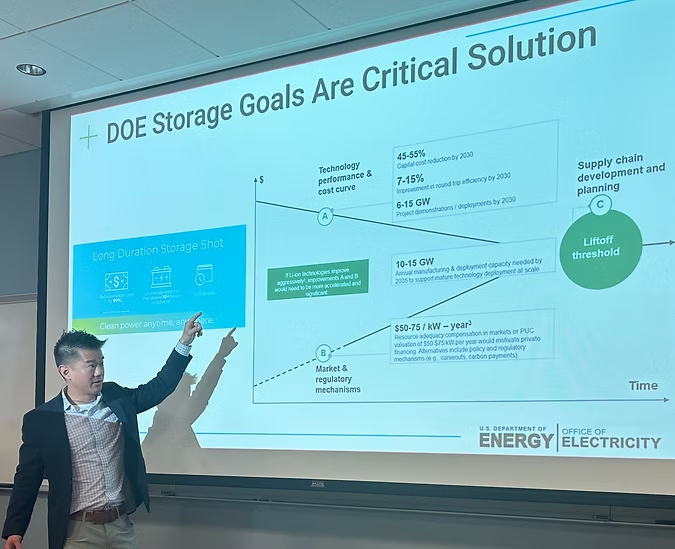
Presentation by Eric Hsieh, DoE Deputy Assistant Secretary for Energy Storage, at Zinc Battery Workshop; Photo Provided by Zinc Battery Initiative

Zinc has demonstrated viability as an energy storage solution. With high energy density, wide global availability, and no fear of fire or destruction, it is well suited for several clean energy applications. This confidence is mirrored in the prediction of zinc batteries controlling more of the market as time progresses, reaching 25% by 2050. However, it can by no means rest on its developments. The requirements of energy storage solutions are only getting more strenuous as more renewable production is added to the grid and products such as electric vehicles and data centers pull massive loads with increasing rapidity. In the race between energy production and energy storage, zinc will undoubtedly be a factor, but it remains to be seen to what degree.

Buy JNews
ADVERTISEMENT
From The Energy Pioneer

Meet EP Investing — now live and free through July 15th.

1,300+ companies · 350+ investors · 185+ grants. Capital discovery for the energy transition.

EP Investing is now live
Register Free →
ShareTweetShare
Otto Gunderson

Otto Gunderson

Otto Gunderson has been working in clean energy for the last 7 years, with the last two being spent split between South America, Africa, and Southeast Asia, reporting on the transition to clean energy. After traveling and writing for two years, he founded The Energy Pioneer to create a news outlet with a global approach to clean energy journalism. He particularly enjoys writing about entrepreneurship, investment, and innovations that are contributing to greenhouse gas reduction and clean energy development.

Related Posts

When the Lights Came On: Zimbabwe’s Rural Electrification and the Return of Local Wildlife
Clean Tech

When the Lights Came On: Zimbabwe’s Rural Electrification and the Return of Local Wildlife

April 23, 2026
Iran War Triggers Oil Shock as Zimbabwe Turns to Ethanol Blending
Renewable Energy

Iran War Triggers Oil Shock as Zimbabwe Turns to Ethanol Blending

April 8, 2026
Africa’s EV Future May Depend on Electrifying the Informal Sector
Clean Tech

Africa’s EV Future May Depend on Electrifying the Informal Sector

April 22, 2026
The Modular Approach to Direct Air Capture
Clean Tech

The Modular Approach to Direct Air Capture

April 1, 2026
Lithium Lockdown: Zimbabwe’s Big Bet on Local Processing
Clean Tech

Lithium Lockdown: Zimbabwe’s Big Bet on Local Processing

April 1, 2026
Caught Between India’s Military Ambitions and Green Promises: The Future of the Andaman and Nicobar Islands
Renewable Energy

Caught Between India’s Military Ambitions and Green Promises: The Future of the Andaman and Nicobar Islands

March 19, 2026
Next Post
Illuminating Pathways: The Power of Energy Access, Efficiency, and Strategic Development

Illuminating Pathways: The Power of Energy Access, Efficiency, and Strategic Development

The Roadblocks to Steel Decarbonization

The Roadblocks to Steel Decarbonization

Popular Stories

  • Caught Between India’s Military Ambitions and Green Promises: The Future of the Andaman and Nicobar Islands

    Caught Between India’s Military Ambitions and Green Promises: The Future of the Andaman and Nicobar Islands

    0 shares
    Share 0 Tweet 0
  • The Race to Host AI: Data Centres in Water-Scarce India

    0 shares
    Share 0 Tweet 0
  • South Sudan’s Missed Opportunity: Untapped Renewables Leave Millions in the Dark

    0 shares
    Share 0 Tweet 0
  • Two Paths Forward: How The Iran Conflict Is Reshaping the Energy Sector

    0 shares
    Share 0 Tweet 0
  • Iran War Triggers Oil Shock as Zimbabwe Turns to Ethanol Blending

    0 shares
    Share 0 Tweet 0

Actionable Info

From The Energy Pioneer

Meet EP Investing — now live.

1,300+ companies · 350+ investors · 185+ grants

Free through July 15th

Register Free →

The Energy Pioneer

The Energy Pioneer covers the global energy transition — from clean tech and green finance to policy and renewable energy.

Recent Posts

  • Vietnam’s Oil Buffer Faces Pressure as the Iran War Disrupts Global Oil Flows
  • Building a Resilient Planet: A Conversation with the United Nations Environment Programme
  • When the Lights Came On: Zimbabwe’s Rural Electrification and the Return of Local Wildlife

Quick Links

  • Home
  • Clean Tech
  • Renewable Energy
  • Green Finance
  • Policy
  • Regions
  • Features
  • Who We Are

© 2026 The Energy Pioneer | All Rights Reserved. |

No Result
View All Result
  • Home
  • Clean Tech
    • Electric Vehicles
    • Energy Efficiency
    • Green Hydrogen
    • Smart Grid
    • Battery Storage
  • Green Finance
    • Public Financing
    • Private Financing
    • Carbon Markets
  • Policy
  • Renewable Energy
    • Wind
    • Solar
    • Hydropower
    • Nuclear
    • Hydrogen
    • Fossil Fuels
    • Geothermal
  • Regions
    • Africa
    • Asia
    • Europe
    • North America
    • Latin America
    • West Asia
  • Features
  • Who We Are
    • About Us
    • EP Investing
    • Contact Us

© 2026 The Energy Pioneer | All Rights Reserved. |